
About this book
If you want a tattoo of a mythical beast, a god or Buddha, or a figure from myth or history, it's best to know first where it comes from and what conventions go with it. This book starts with where tattooing itself comes from, then moves through Japanese-style tattooing and ukiyo-e, China's mythical beasts and figures from myth, Indian and Buddhist subjects, and Western mythology. It takes the subjects common in tattoos one question at a time and explains them clearly: 35 questions in all. Understand it first, then get tattooed, and you'll be able to talk it through clearly with your tattoo artist.
As with the earlier books, this book was written to answer questions, clear up doubts and genuinely help. So there's no selling and no price list here, only where these subjects come from and the things to watch out for in the design. Free ebook.
The Foreword and the five part-opening quotes are adapted from videos in which Wang Lei speaks on camera himself; only the spoken style has been smoothed into written form. The main text is based on Lei Shi Tattoo's educational Q&A videos on tattooing, mostly presented on camera by Kong Shan, the host of Lei Shi Tattoo's educational videos. Before publication, the sources of every question in the main text were checked against the video transcripts, and the quotes were checked line by line.
This is the English edition of 《纹身题材35问》.
Contents
Foreword (Wang Lei) · About This Book
Part One · Where Tattooing Comes From
- When did people first start getting tattooed?
- Getting a tattoo was so risky in ancient times. Why did people still do it?
- Are tattoos and totems the same thing?
- Did people in ancient China get tattoos?
- Did people in the Song dynasty compare tattoos too?
- Why do people get tattoos?
Part Two · Japanese-Style Tattooing and Ukiyo-e
- How did Japanese traditional tattooing take off?
- Which artists should I look at if I want my tattoo to capture the feel of ukiyo-e?
- Why do characters from Water Margin and Miyamoto Musashi show up so often in Japanese-style tattoos?
- Why does Japanese traditional always come back to the same few flowers, and to mountains, water and waves?
- Do Japanese traditional tattoos look tacky?
- What is Hannya (般若), and how do you pronounce it?
- What is a karajishi, can it have horns, and what colors look good on one?
Part Three · China's Mythical Beasts, Myths, and Figures
- My dragon-and-phoenix full bodysuit is done. What should go on the two remaining full sleeves?
- Can I get a mythical beast from the Classic of Mountains and Seas tattooed?
- Where did the gods in myths come from?
- I want a tattoo of the Black and White Impermanence or Tudi Gong. Is there anything to watch out for?
- Is there anything to watch out for when tattooing historical and fictional figures like Bai Qi and Wu Song?
- What should I know about red spider lily and crane tattoos?
- How do you make a good Chinese-style ink-wash tattoo?
Part Four · India, Buddhism and Southeast Asia
- Where does the Three-Faced Buddha come from?
- Why does Ganesha have an elephant's head?
- Who are Garuda and Asura?
- What should I know before getting a Buddha from a thangka?
- How is a Thai sak yant different from an ordinary tattoo?
Part Five · Western Mythology and Foreign Subjects
- Where did the Greek gods come from?
- Who is Poseidon?
- How do you tell Poseidon apart from Zeus in a tattoo?
- Why is Medusa so often tattooed?
- What does it mean when a tiger has horns on its head?
- What do a goat's head and a red dragon mean in the West?
- How should I understand Cthulhu and cyberpunk tattoos?
- Are the seven deadly sins about bad people?
- Can I get angels and devils, or Michael and Lucifer, tattooed together?
- What do people get in Chicano tattoos, and why are skulls so popular?
Sources
About the author
Wang Lei is a tattoo artist and the founder of Lei Shi Tattoo (雷势文化, LEI SHI TATTOO).
He learned to tattoo on pigskin bought at the market for a yuan or two a piece. As a young man waiting tables at a karaoke bar, he fell for a small eagle tattooed on a friend's stomach, scraped and borrowed the money to pay an apprenticeship fee, and started tattooing professionally in 2003. At the end of 2006 he opened his own studio, Wang Lei Tattoo, in Di'anmen, Beijing. Since 2010 he has taught tattooing, training more than 3,000 students.
In 2013 Wang Lei Tattoo became Lei Shi Tattoo and opened a studio in Sanlitun; in 2016 it opened the Baiziwan studio, now its Beijing flagship. That same year Lei Shi went to Burning Man in Nevada's Black Rock Desert for the first time and set up a tattoo camp. In 2018 Wang Lei curated Pale Blood, an independent tattoo art exhibition in Langfang, and in 2019 Lei Shi built a desert tattoo camp at the Gobi Heaven art carnival in Bayannur, Inner Mongolia.
Today Lei Shi Tattoo has 11 studios in mainland China, plus one in Johor Bahru, Malaysia (its first overseas studio, opened in 2024). After more than twenty years of tattooing, the line Wang Lei repeats most often is: service comes first; only then can you talk about art.
Lei Shi Tattoo (雷势文化, also written 雷势刺青) was called Wang Lei Tattoo (王雷刺青) from 2006 to 2013. About Wang Lei and Lei Shi →
Publication details
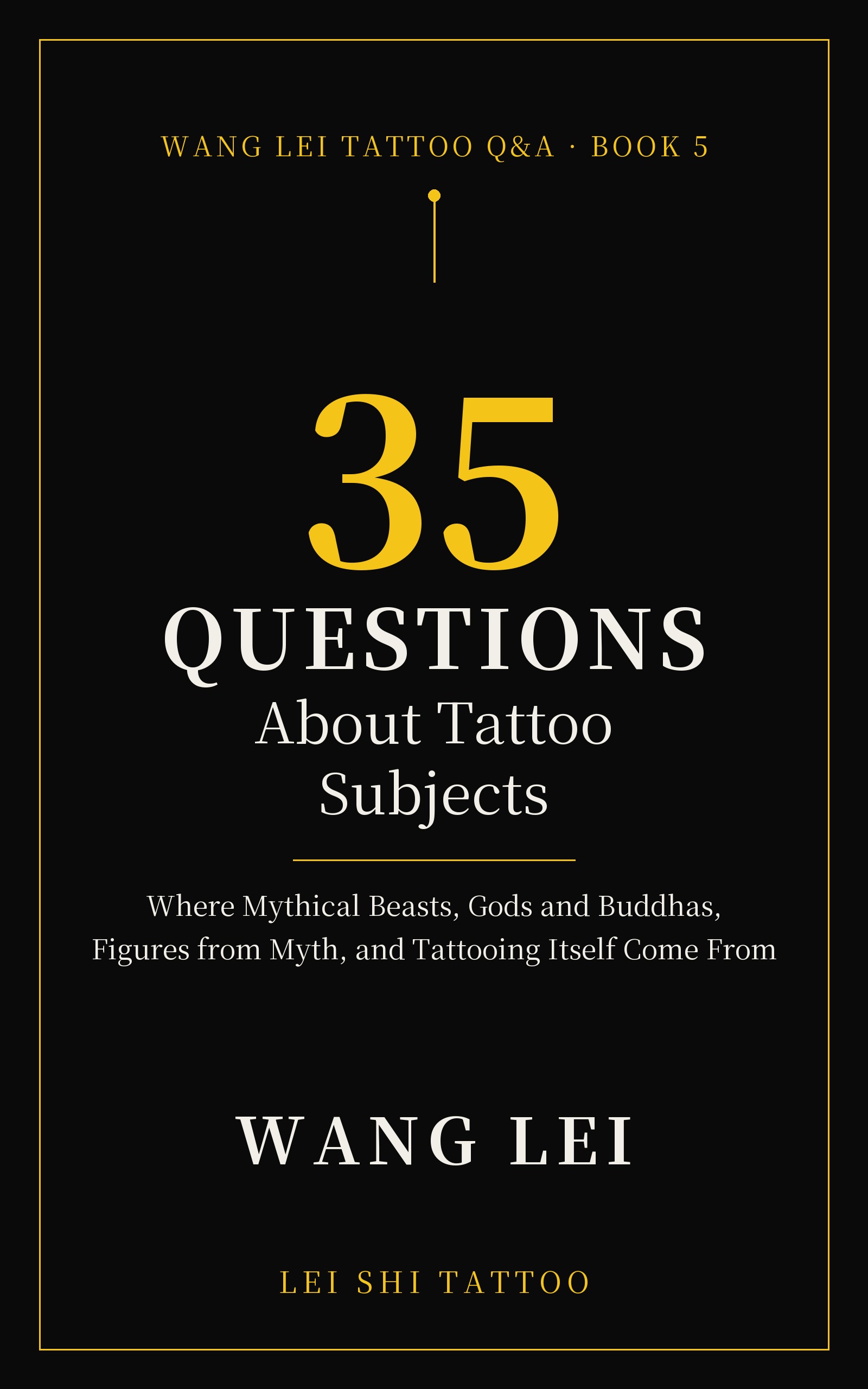
- Title 35 Questions About Tattoo Subjects: Where Mythical Beasts, Gods and Buddhas, Figures from Myth, and Tattooing Itself Come From
- Series Wang Lei Tattoo Q&A · Book 5
- Author Wang Lei
- Produced by Lei Shi Tattoo
- Language English (translated from the Chinese edition, 《纹身题材35问》)
- Format Ebook (EPUB)
- Price Free
- Publication January 2027 (planned)
- eISBN pending
This book offers general guidance based on a tattoo studio's experience. It does not replace diagnosis or treatment by a doctor.